One
World Symphony welcomes you…
Back… to The Town
Hall!
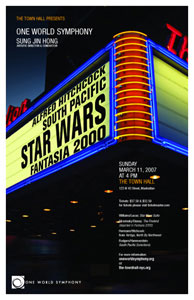
Williams/Lucas: from Star Wars, The Empire Strikes Back and The Phantom Menace
Stravinsky/Disney: The Firebird (depicted in Fantasia 2000)
Herrmann/Hitchcock: from Vertigo, North By Northwest
Rodgers/Hammerstein: South Pacific (Scenes)
Program Notes
By Elizabeth Weinfield
New York’s hippest orchestra returns to The Town Hall in March 2007, one year after its triumphant debut, with a theatrical bill designed to wow any audience and make it sing. “We could hardly wait to come back to Town Hall,” says violinist Sarah Badavas, when the news of the rebooking spread through the orchestra. Many will remember last year’s surprising encore in which conductor, Sung Jin Hong, asked his long-time partner, managing director, Adrienne Metzinger, for her hand in marriage. The audience’s roar of applause rivaled their shouts of “Mambo!” which had echoed through the hall, accompanying the orchestra in West Side Story earlier in the program. Another life-altering event this year? “Well, maybe not a marriage proposal,” laughs Hong, “but I guarantee you there will be plenty of surprises up our sleeves!” A program dominated by film music presents the orchestra with the opportunity to experiment with theatricality, and in this sense it reveals Hong and his musicians at their best. As the ensemble brings to the fore what is, in essence, meant as background, they fulfill the mission of this orchestra: to inspire, engage and explore the universality of music by inviting participation.
Bernard Herrmann’s reputation may today be outshone by that of his co-collaborator, Alfred Hitchcock, but the two men equal one another in artistic significance. Hermann was an advocate of contemporary music, and as the Chief Conductor for the CBS Symphony Orchestra, a role he would take on in 1943, he did more to introduce the American audience to new music than any other conductor before him. In his film music, a novel orchestration results from his meticulous desire to have the score stand on its own. Such is the case in Herrmann’s score for Vertigo, considered one of the best scores in cinematic history. While Hitchcock manipulates the cinematography, famously distorting the perspective that gives the film its title, Hermann employs Wagnerian melodies than unearth the deeply rooted powers of the human condition, all of which cast a more probing light onto the interpretation of the film. This is particularly powerful in the Scène d’amour, where a theme reminiscent of Tristan und Isolde betrays an obsessive love.
With every interpretation since its controversial première by Diaghilev’s Ballets Russes in Paris in 1910, music from Igor Stravinsky’s ballet The Firebird continually redefines its own modernity. “Watch him well,” Diaghilev is said to have remarked of the composer and of his avante-garde approach to the tonal environment.“He is a man on the eve of celebrity.” From the harsh rhythmic pulsations in the brass and strings to the sexy, French-inspired tonality that sifts through the winds, every instrument is personified, veritably choreographed for the stage. The plot depicts the tumultuous journey of Prince Ivan to the magical realm of the Kastchei; the hero eventually meets the Firebird and falls victim to infernal dances and sleep-inducing wizardry. In addition to the original 50-minute ballet score, the piece now exists in three suites for orchestra that Stravinsky arranged for the concert stage. Today’s performance makes use of the 1919 version, the most commonly performed arrangement.
South Pacific had its première on Broadway on April 7, 1949, with original music by Richard Rogers and lyrics by Oscar Hammerstein II. Based on two short stories by James A. Michener, the musical was awarded the Pulitzer Prize for Drama in 1950 and would run on Broadway for over five years. Rogers and Hammerstein collaborated successfully as a duo throughout the 1940s and 1950s, creating a total of nine musicals together during the so-called “Golden Age” of Broadway, and a legacy in the genre that has yet to be equaled.
Music from the original epic trilogyStar Wars would not only win John Williams both an Academy and a Grammy Award, but it would also propel into the cultural consciousness a universal music, uniting fans everywhere and inspiring them alike. Williams was born in Los Angeles and studied piano at the Juilliard School in New York, where he supported himself as a jazz musician before devoting himself entirely to film collaboration. A prosperous professional relationship with director, Stephen Spielberg, would eventually lead Williams to George Lucas, creator and director of Star Wars, for which he would create a score selected in 2005 by the American Film Institute as the greatest American movie score of all time. Like Bernard Herrmann before him, Williams employs the Wagnerian concept of leitmotiv: each character is given his or her own thematic music, a device that allows the listener to recognize film’s protagonists and predict their interactions.
Sunday, March 11 , 2007
The Town Hall
Manhattan