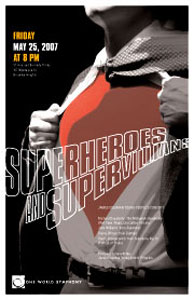
Superheroes and Supervillains
James Coleman Young People’s Concert
To learn more about James Coleman, please click here.
Dmitri Shostakovich: from Symphony
No. 10 (1953: Portrait of Stalin)
Michael Daugherty: The Metropolis Symphony (1988-1993:
Lex, Red Cape Tango)
John Williams: from Superman (1978)
Length of Program: 75 minutes
Program Notes
After its triumphant concert held at New York City's The Town Hall to capacity audiences, One World Symphony returns to embrace eclecticism in music. Infused by classical, rock, and pop culture, Michael Daugherty's Metropolis Symphony celebrates one of America's most beloved superheros and his arch-nemesis Lex Luthor. Dmitri Shostakovich's monumental Tenth Symphony, considered to be a "portrait of Stalin," may have been a profoundly personal expression what life was like, not just for Shostakovich himself, but for millions of individuals during Stalin's regime. Even to the present, is Stalin considered a hero, villain, or beyond category? For the soaring and heroic Superman by John Williams, elementary school violin students from The Promise Academy from the Harlem Children's Zone will join One World Symphony. This diverse program is both a tribute and a remembrance for an outstanding musician and friend, James Coleman.
Michael Daugherty (b. 1954) is one of the most performed and commissioned American composers of his generation. Daugherty came to international attention with his Metropolis Symphony (1988-93), a tribute to the Superman comics. Daugherty has received numerous awards for his music, including the Stoeger Prize from the Chamber Music Society of Lincoln Center, recognition from the American Academy and Institute of Arts and Letters, and fellowships from the Guggenheim Foundation and National Endowment for the Arts.
Daugherty describes The Metropolis Symphony (1988) as:
"The Metropolis Symphony evokes an American mythology that I discovered as an avid reader of comic books in the fifties and sixties. Each movement of the symphony -- which may be performed separately -- is a musical response to the myth of Superman. I have used Superman as a compositional metaphor in order to create an independent musical world that appeals to the imagination. The symphony is a rigorously structured, non-programmatic work, expressing the energies, ambiguities, paradoxes, and wit of American popular culture. Through complex orchestration, timbral exploration, and rhythmic polyphony, I combine the idioms of jazz, rock, and funk with symphonic and avant-garde composition.
Lex derives its title from one of Superman's most vexing foes, the supervillain and business tycoon Lex Luthor. Marked "Diabolical" in the score, this movement features a virtuoso violin soloist (Lex) who plays a fiendishly difficult fast triplet motive in perpetual motion, pursued by the orchestration and a percussion section that includes four referee whistles placed quadraphonically on stage.
Red Cape Tango was composed after Superman's fight to the death with Doomsday, and is my final musical work based on the Superman mythology. The principal melody, first heard in the bassoon, is derived from the medieval Latin death chant Dies irae. This dance of death is conceived as a tango, presented at times like a concertino comprising string quintet, brass trio, bassoon, chimes, and castanets. The tango rhythm, introduced by the castanets and heard later in the finger cymbals, undergoes a gradual timbral transformation, concluding dramatically with crash cymbals, brake drum, and timpani. The orchestra alternates between legato and staccato sections to suggest a musical bullfight."
In March 1953, Dmitri Shostakovich (1906-1975) awoke to the news that Stalin was dead. His first professional act was to release the works he had withheld from performance; that summer he cleared his desk and began a new symphony, which he wrote at lightning speed. Even though Shostakovich may have sketched his Tenth Symphony as early as 1946, it seems clear that he worked extensively and urgently on the symphony only after Stalin1s death. This is music of a new beginning, at once summing up all that Shostakovich had to say, releasing everything that the years of Stalin's oppression had buried and anticipating a fresh and enlightened era ahead. The Tenth Symphony premiered in Leningrad in December 1953 to a mixed response. In March 1954 the Moscow branch of the Union of Soviet Composers even called a special three-day conference to debate this important symphony, already recognized as a pivotal work in the history of Soviet music. Many didn't know how to place it within the context of Social Realism that had governed Soviet composers since 1932. Some were put off by its apparent pessimism. Finally, in the elaborately ambiguous language that often springs from political gatherings, the young composer Andrei Volkonsky pronounced the Tenth Symphony an "optimistic tragedy." Continuing a One World Sympony tradition, conductor Hong and the orchestra will share their insights and demonstrations for curious minds.
Some of John Williams' (b. 1932) iconic film scores have been Superman, Jaws, Raiders of the Lost Ark, Star Wars, Schindler's List and recently, the first three Harry Potter films. Williams first composed the Superman score for the first motion picture in 1978, and the themes have become instantly recognized and identified with the character, used subsequently for both the film Superman Returns and the hit TV show Smallville.
The opening title march literally soars off the screen, accompanying the opening title sequence of credits flying through space. In composing the theme, Williams was inspired by previous themes for the character, which relied heavily on the relationship of the dominant fifth. By using this melodic arrangement, the music itself seems to sing the name "Superman" as if it were a lyric. The rising trumpets triumphantly proclaim the name Superman, while the soaring violin arpeggios give the sensation of joining Superman in flight.
In the love theme Williams scores a complete scene that plays without dialogue, effectively communicating the story of Lois Lane's first night flying with Superman. Starting calm and reserved, the music takes flight as the couple does. The call-and-response of the music develops the relationship between them, ultimately leading to the full rendition of Can You Read My Mind. The music follows the pair into a gentle landing, before Superman flies into the night sky leaving a love-struck Lois standing on her balcony.
-- Sung Jin Hong, Michael Daugherty, and Nick Martorelli
Friday, May 25, 2007
St. Ann and the Holy Trinity
Brooklyn Heights